Introduction
In today’s fast-paced manufacturing and warehousing environments, efficiency, safety, and consistency are paramount. Palletizing robots have become essential tools in achieving these goals. Designed to automate the stacking of goods onto pallets, these robots not only reduce manual labor but also ensure precise and repeatable pallet structures. However, the real advantage lies in how these robots are programmed—especially when it comes to layering and maintaining load stability.
This article explores the principles behind programming a palletizing robot effectively, with a focus on how to optimise layering strategies and ensure secure, stable loads during material handling.
Understanding Palletizing Robots
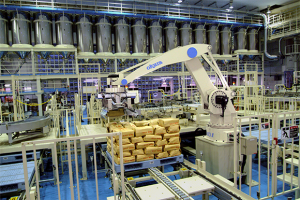
A palletizing robot is an automated machine, typically with an articulated robotic arm, that stacks products such as cartons, boxes, or bags onto a pallet. These robots can be integrated into conveyor systems and are often equipped with end-of-arm tooling (EOAT), sensors, and vision systems to interact accurately with incoming items.
The goal of a palletizing robot is to create tightly packed, stable pallet loads with speed and precision—minimising product damage and optimising space during transport and storage.

The Role of Programming in Palletizing
Programming defines how a palletizing robot performs its tasks. Key aspects of programming include:
- Pick-up sequence: Determining the order and orientation of items to be picked.
- Pallet pattern: Defining how items are arranged in each layer.
- Stacking logic: Accounting for box size, weight, and stability.
- Safety zones: Preventing collisions with human workers or machinery.
- Error handling: Automatically adapting to missing or malformed items.
Advanced programming also allows robots to dynamically adapt to multiple SKUs, changing product dimensions, or unexpected conveyor conditions without halting operations.
Best Practices for Layering in Palletizing Robots
Layering is crucial to the integrity of a pallet load. Improper patterns can lead to unbalanced stacks that shift or collapse during handling. The following programming considerations can help ensure optimal layering:
1. Interlocking Patterns
Create interlocked (brick-style) patterns that offset products between layers. This improves load stability and evenly distributes weight.
2. Layer Alternation
Alternate layer orientations (e.g., rotating every second layer) to prevent vertical seams and reduce toppling risks.
3. Void Minimisation
Ensure each layer has minimal empty space. Programming should account for product dimensions and orient them to maximise density.
4. Weight Distribution
Heavier items should be placed at the bottom of the stack. Programming logic must consider weight constraints for each layer.
5. Corner Alignment
Keep corners of the stack aligned vertically. Robots should place products with precision to maintain structural integrity throughout the pallet height.

Ensuring Load Stability: Key Strategies
Programming must also address overall load stability, especially for tall or irregular loads:
- Centre of Gravity Control: Ensure items are placed to maintain a central, low centre of gravity. This reduces tipping risks.
- Overhang Avoidance: Avoid placing items so that they extend beyond the pallet edge, which weakens load support.
- Stretch Wrapping Integration: Sync robot output with wrapping systems for additional stability during shipping.
- Feedback Loops: Use sensors or vision systems to verify placement accuracy in real-time and adjust accordingly.
Modern palletizing robots can be programmed to use real-time data from barcode scanners, weight sensors, or vision cameras to adapt their stacking logic on the fly.
Common Programming Tools and Techniques
Programming environments for palletizing robots vary by manufacturer, but common platforms include:
- Offline Simulation Software: Allows engineers to model and test stacking patterns before deployment.
- Graphical Programming Interfaces: User-friendly tools to drag and drop pallet patterns and define motion paths.
- PLC Integration: Enables seamless communication with upstream/downstream systems such as conveyors, labelers, and wrapping machines.
- AI & Vision Systems: Advanced systems allow robots to identify object types, detect defects, and correct misaligned items without operator input.
Applications Across Industries
Palletizing robots are widely used across multiple industries:
- Food & Beverage: Stacking cartons or crates of beverages, often in varied SKU sizes.
- Consumer Goods: High-speed palletizing for packaged items with branding considerations.
- Logistics & Warehousing: Adaptive palletizing for e-commerce or mixed-load shipments.
- Agriculture: Stacking bagged products like fertilizer, grains, or animal feed.
Each industry may require different stacking logic and programming depending on product fragility, speed requirements, and pallet configurations.
Conclusion
A well-programmed palletizing robot is more than a machine—it’s a strategic asset that enhances workflow, reduces risk, and increases productivity. By paying close attention to layering techniques and load stability during the programming phase, businesses can ensure their palletizing operations are efficient, reliable, and ready for the challenges of modern logistics.
At Okura Singapore, we specialise in delivering customised robotic palletizing solutions tailored to your production needs. Our systems are designed for maximum flexibility, performance, and uptime. Contact us today to learn how our palletizing robots can transform your material handling processes.