Introduction
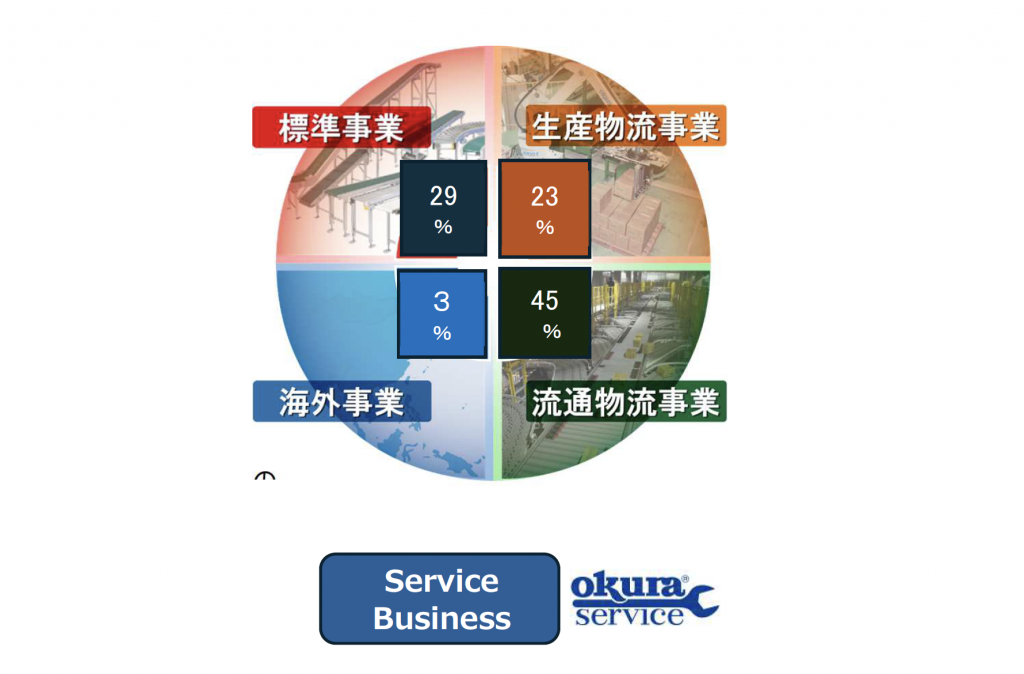
Our company is a comprehensive material handling manufacturer that will celebrate its 100th anniversary in 2027. As shown in Figure 1 on the right, our business domains include: the Standard Business, focused on lightweight conveyor systems; the Factory Automation Business, focused on robotic and mechanical palletizers; the Logistics Business, focused on sorters, picking systems, and GTP (Goods- to- Person) systems; and the Overseas Business, which expands the products from these three businesses into global markets. In addition, we operate a Service Business focusing on installation and maintenance.
In particular, together with Okura Service Co., Ltd., which is responsible for our service operations, we are fully committed to ensuring “uninterrupted flow” for the systems we deliver to customers. To maintain these systems, we provide comprehensive support with a robust service structure. We take pride in our industry-leading service network covering all of Japan, from Hokkaido in the north to Kyushu in the south.
In this article, we will introduce key points when implementing material handling equipment, challenges that arise after installation, and in particular, case studies of control system upgrades, as well as our initiatives in remote monitoring and predictive maintenance to ensure long-term use of the equipment.
Recent Initiatives in Automation
As the “2024 Logistics Problem” has become more pronounced, modal shift initiatives have accelerated in recent years. While this shift originated from a shortage of truck drivers, it is also linked to the reduction of CO₂ emissions —one of the key challenges in achieving the SDGs —making it an increasingly important area of focus. For example, companies that primarily ship products on pallets can no longer use uniquely shaped pallets as they did in the past if they wish to adapt to the modal shift. As a result, efforts to standardize pallet sizes for integrated palletization —specifically adopting the 1100 mm square pallet —are rapidly expanding.
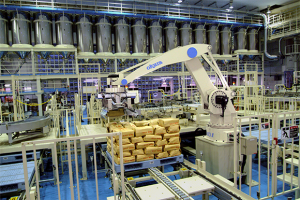
Against this backdrop, our company has introduced solutions such as a vision- equipped robotic system for automatically transferring loads from large pallets to 1100 mm square pallets, a large truck loader capable of loading 20 pallets at once, a compact truck loader/ unloader that can automatically load and unload two pallets at a time, and a heavy- duty telescopic conveyor (extending from 5 m to 24 m) that allows workers to unload directly from trucks and containers. Through these products (see Photos 1, 2, 3), we support our customers in putting concrete measures in place to address the 2024 Logistics Problem.
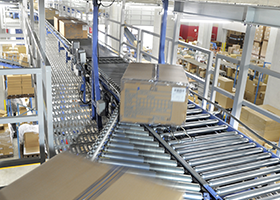
In addition, in distribution centers and manufacturing sites, chronic labor shortages caused by declining birthrates and an aging population have made it increasingly important for companies to create and promote their appeal as “Employer of choice” in order to secure talent. In this environment, companies that advance automation in the material handling field are likely to have an advantage in attracting and retaining personnel. For this reason, in recent years, we have been proposing “Operator-Friendly” systems for logistics centers— such as various GTP (Goods-To-Person) systems (see Photos 4, 5, 6)—that allow picking without requiring operators to walk around.
When considering the introduction of such automated material handling systems, we believe customers will evaluate manufacturers from various perspectives. However, at the time of selection, the most important point to focus on is whether the manufacturer can continuously provide maintenance, partial renewals, and functional enhancements to ensure long- term use of the equipment. Below, we will present the challenges and case studies related to these aspects.
Challenges After the Introduction of Automated Equipment Discontinued Components
Even if the mechanical lifespan of equipment remains in good condition, there are cases where control devices must be updated due to discontinued production or to enhance functionality. This is necessary to ensure that customers can continue to use the equipment with confidence after installation. For example, In general, the lifespan of control components is said to be around 7 to 10 years. If replacement parts can be procured smoothly, there is no problem. However, if the manufacturer has already discontinued production of a part, or has issued a discontinuation notice, it is essential to prepare countermeasures—such as securing alternative components —before deterioration leads to serious problems.If the discontinued part is one that affects the entire equipment system, and no alternative part can be sourced, the worst-case scenario may require replacing the entire system, including the mechanical portion, as extending the life of the equipment would otherwise be difficult. In fact, we encountered a case in which a
distributed control wiring system was discontinued with no successor model available. In response to this production discontinuation of the control system, we carried out both hardware and software updates, and the customer was very satisfied with the results. The following is a case study of that project.
Challenges After the Introduction of Automated Equipment ②Example of Control System Renewal
Our company, along with others in the material handling industry, has long adopted the S-LINKV wiring-reduction system.
S-LINKV is a flexible wiring-reduction system that simplifies the wiring of sensors and actuators in factory automation (FA) environments, enabling efficient layout design. Figure 2 shows a configuration using S-LINKV.
S-LINKV supports up to max. 512 control points and a communication distance of up to 800 meters, while offering flexibility to connect with various PLCs and open networks. Due to these advantages — improved electrical work efficiency and improved design efficiency —it had been in use for many years. However, we received a manufacturer’s notice of production discontinuation, with no successor model planned.
In response, we urgently investigated alternatives with equivalent functionality and identified a product called ASLINK.
ASLINK is a wiring-reduction system that not only reduces wiring but also adds
features such as disconnection detection and sensing-level monitoring. Specifically, its functions include:
- Disconnection detection: Detects breaks in transmission lines or sensor cables and identifies which unit has been disconnected, enabling rapid troubleshooting in the event of an abnormality.
- Sensing-level monitoring: Monitors actual measured values in addition to sensor ON/OFF states, allowing the sensor’s condition to be understood and enabling preventive maintenance before failures occur.
By adopting ASLINK, improvements in equipment uptime and maintenance efficiency can be expected after installation. Figure 3 shows a configuration using ASLINK.
From a hardware perspective, the connection to the PLC via a gateway remains unchanged, so by updating the system beyond the gateway, it is possible to smoothly replace equipment installed with S-LINKV to ASLINK.
For photoelectric switches, adopting ASLINK- compatible sensors enables detection of simple issues such as optical axis misalignment. Figures 4 and 5 show the sensor light-level shortage detection screen and the sensor identification screen. By checking these screens, customers themselves can easily grasp issues with photoelectric switches, which has led to a significant reduction in emergency on- call requests to Okura Service Co., Ltd .’s service center for customers who have introduced this wiring-reduction system and ASLINK sensors in their new equipment.
As mentioned earlier, given the typical 7– 10 year lifespan of control components, we actively propose upgrading to ASLINK to customers who previously received systems using S- LINKV, in order to prevent downtime caused by S- LINKV- related failures. To date, including orders and completed projects, we have carried out replacement work on several dozen systems.
The main work involves CPU upgrades, addition of CC- LINK IE Field, replacement of gateway and channel units, and replacement of trunk cables, while many other hardware components are often reused.
The adoption of ASLINK has not only reduced the amount of wiring, but also made it With the adoption of ASLINK, not only has wiring been reduced, but sensor light levels can now be visualized and cable disconnections detected. In addition, there is growing demand for systems that can remotely monitor equipment abnormalities, the outline of which is presented below.
Challenges After the Introduction of Automated Equipment ③Remote Monitoring System for Rapid Response in the Event of Trouble
When trouble occurs after equipment installation, rapid restoration, thorough root cause analysis, and preventive measures to avoid recurrence are essential. In particular, when a problem arises in a project involving multiple control panels, the cause may be complex and involve interactions between panels. When trouble occurs after equipment installation, rapid restoration, thorough root cause analysis, and preventive measures to avoid recurrence are essential. In particular, when a problem arises in a project involving multiple control panels, the cause may be complex and involve interactions between panels.
Through this IoT package, we have established a mechanism to remotely detect common abnormalities. In recent years, however, there has been increasing demand for systems that can detect subtle “changes” before equipment stops, by monitoring conditions using various sensors —not only for control purposes, but also for vibration, temperature, and other parameters —and taking preventive measures in advance. In the next section, we will introduce the lifecycle maintenance initiatives being promoted by our group.
Issues after introducing automated equipment ④Lifecycle maintenance initiatives
In addition to updating control systems and remote monitoring systems , our group is sincerely addressing the major challenge of ” ensuring that our customers ‘ equipment does not stop operating , ” and we position lifecycle management and maintenance as the ultimate means to achieve this . Lifecycle maintenance is the process of keeping equipment in operation effectively and for the long term.
This is an initiative to use the product for long-term use, and is also an important initiative from the perspective of SDG.
Issues after introducing automated equipment: Pitfalls of deterioration of electric wires and cables
Electric wires and cables are often overlooked in lifecycle maintenance. The estimated service life of a cable when used under normal conditions is generally 15 Year ~ 30 Although it is said to last about 1 year , this varies greatly depending on the installation environment and usage conditions , making it difficult to predict the lifespan in general .
In our group , 20 during maintenance , we discovered that the power lines of a conveyor system that had been in operation for over 10 years had deteriorated . Fortunately , no serious problems occurred , but if the problem had gone unnoticed and left unattended, it could have led to a sudden shutdown of the system or , in the worst case , a fire . It is important to understand that wires and cables deteriorate due to a variety of factors , and that if signs of deterioration are observed , they must be replaced immediately . It should not be forgotten that classic methods of checking equipment using sight , hearing , and touch are also important for stable operation.
Conclusion
Above , we have introduced our group ‘s efforts regarding maintenance and updates after the installation of material handling equipment, remote monitoring , lifecycle maintenance , etc. When installing equipment , we believe that our challenge as a manufacturer is to make proposals from the customer ‘s perspective and provide equipment that can be used safely for a long period of time.From this perspective , although there is a certain amount of cost involved , we propose the control system updates introduced here , remote system monitoring for stable operation , status monitoring using sensors , lifecycle maintenance , etc.
As IoT connectivity for equipment becomes increasingly important and the use of generative AI expands, we will continue to evolve and provide services such as visualization of operating status through dashboards and support and backup in the event of trouble through chat systems, thereby helping customers improve their productivity. We also hope to support our customers as a group by working together on lifecycle maintenance.