Introduction
As industries expand in scale and complexity, material handling systems must evolve to keep up with growing demands. Conveyor belts remain one of the most critical components of efficient operations, enabling continuous movement of goods across warehouses, manufacturing plants, and distribution centers. But in 2025, designing a conveyor belt system requires more than just mechanical know-how, it demands integration of smart technologies, energy efficiency, and future-proof scalability.
This article outlines the key considerations in designing a conveyor belt system for material handling, explores modern components and innovations, and highlights emerging trends that are shaping the future of conveyor technology.
How to Design a Conveyor Belt System: Key Considerations
When asking how to design a conveyor belt system in today’s context, engineers and decision-makers must balance performance, safety, cost, and sustainability. The process begins with answering several fundamental questions:
- What materials are being transported?
Bulk materials (coal, grains, ores) require heavy-duty belts, while packaged goods need precise, controlled movement. - What throughput rate is required?
The design must account for hourly or daily volume targets, ensuring the conveyor can handle peak loads. - What space and layout constraints exist?
Straight, curved, inclined, and modular conveyors can be combined to fit unique facility footprints. - What safety and compliance requirements apply?
Local and international standards (e.g., ISO, OSHA) should influence design choices.
By addressing these factors early, businesses can avoid costly retrofits and ensure systems are built for long-term success.
Core Components of a Conveyor Belt System
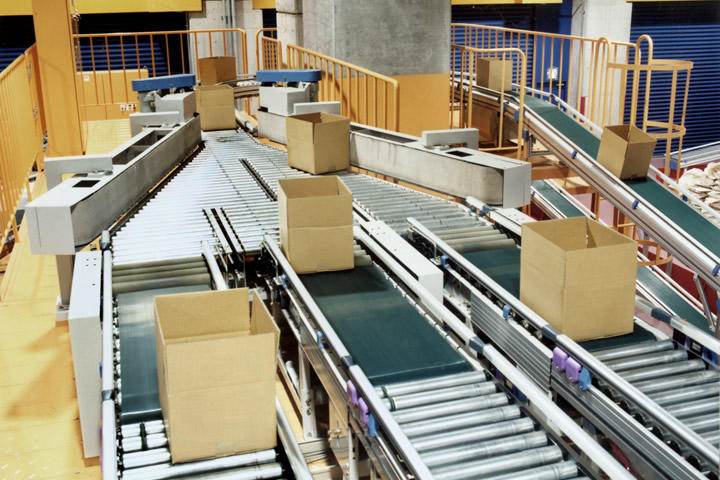
A modern conveyor belt system is composed of several interconnected parts, each influencing performance and durability:
- Belt Material
- Rubber: Heavy-duty, abrasion-resistant, ideal for mining and aggregates.
- PVC or PU: Lightweight, cost-effective, and common in logistics.
- Modular Plastic: Hygienic and easy to clean, perfect for food and beverage industries.
- Metal Belts: Handle extreme temperatures and heavy loads.
- Drive and Motor Systems
- High-efficiency motors (IE3/IE4 standards) reduce energy consumption.
- Servo motors allow precise speed control for automated processes.
- Variable Frequency Drives (VFDs) enable conveyors to adjust speeds dynamically.
- Rollers and Pulleys
- Provide support and tension management.
- Designed to minimise friction and wear.
- Control Systems
- PLCs (Programmable Logic Controllers) ensure accurate operation.
- Sensors detect load presence, speed variations, and misalignments.
- HMIs (Human-Machine Interfaces) allow operators to monitor in real time.
Designing for Efficiency and Sustainability
Energy efficiency is a top priority in 2025. With electricity costs rising and sustainability goals becoming stricter, conveyor belt systems must be designed to minimise energy consumption without compromising performance.
- Smart Motors: IE4-rated motors and VFDs optimise power use during variable loads.
- Energy Recovery: Regenerative braking captures excess energy and feeds it back into the grid.
- Optimised Layouts: Reducing conveyor length and incorporating gravity-assisted sections where possible.
- Predictive Maintenance: Sensors and IoT platforms detect wear early, preventing energy waste due to misalignment or friction.
These measures not only lower operational costs but also support corporate ESG (Environmental, Social, and Governance) targets.
2025 Trends in Conveyor Belt System Design
The way we design conveyors is changing rapidly. Some of the most notable trends include:
- IoT-Enabled Smart Conveyors
- Real-time data collection for performance monitoring.
- Predictive analytics for proactive maintenance.
- Modular and Scalable Systems
- Easy-to-reconfigure conveyors for seasonal demand shifts.
- Plug-and-play modules for faster installation and upgrades.
- Enhanced Safety Features
- Machine vision for human detection.
- Automated emergency stops and safety zones.
- Compliance with evolving ISO/OSHA standards.
- Sustainability-Focused Materials
- Recyclable belt materials.
- Low-noise, energy-saving rollers.
- Systems designed for circular economy principles.
Conclusion
Understanding how to design a conveyor belt system in 2025 means balancing mechanical engineering principles with digital intelligence and sustainable practices. From choosing the right belt material to integrating IoT-enabled monitoring, today’s conveyor systems must be efficient, safe, and future-ready.
At Okura Singapore, we specialise in designing conveyor systems tailored to industrial automation needs. Our solutions combine robust construction, energy-efficient technology, and smart automation integration, helping businesses achieve operational excellence while staying sustainable.