Introduction
Modern factories and warehouses no longer rely on standalone machines. Instead, they operate as integrated ecosystems—where industrial automation devices such as sensors, actuators, controllers, and robots exchange data in real time. This interconnected environment allows production lines to run smoothly, detect faults instantly, and make automated decisions without human intervention.
The foundation of this seamless communication lies in industrial networks, communication protocols, and integration standards. In this article, we explore how industrial automation devices communicate with one another, the systems that enable interoperability, and why reliable communication is the key to Industry 4.0 success.
Understanding Industrial Automation Devices
Before diving into networks and protocols, it’s essential to understand the different categories of automation devices that must communicate effectively within an industrial setup:
- Sensors – Detect physical parameters like temperature, pressure, proximity, and motion, sending real-time data to controllers.
- Actuators – Perform mechanical movements based on control commands (e.g., motors, valves, and pneumatic cylinders).
- Programmable Logic Controllers (PLCs) – Serve as the central control units that process sensor data and coordinate system actions.
- Human-Machine Interfaces (HMIs) – Enable operators to monitor processes, receive alerts, and input commands.
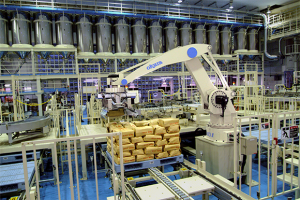
- Industrial Robots and Vision Systems – Execute complex tasks such as palletizing, inspection, and precision assembly.
Each of these components must communicate through standardized systems to ensure synchronization and data accuracy.
How Industrial Automation Devices Communicate
Communication between industrial devices happens through industrial networks—structured systems that transmit data, commands, and feedback across machines. These networks differ from conventional office IT networks because they must deliver:
- High reliability and uptime
- Low latency for real-time control
- Resistance to interference from harsh environments
Communication typically occurs in two directions:
- Horizontal communication: Between devices on the same production level (e.g., robot-to-PLC or PLC-to-HMI).
- Vertical communication: Between field devices and enterprise systems (e.g., connecting factory operations to ERP or cloud analytics platforms).
Common Communication Networks and Protocols
Industrial communication relies on a range of wired and wireless technologies. Each serves a specific purpose based on performance requirements, distance, and environment.
1. Fieldbus Networks
Fieldbus systems were among the first digital communication technologies for automation. They connect sensors, actuators, and PLCs over a shared bus line.
- Examples: PROFIBUS, Modbus, CANopen, DeviceNet
- Benefits: Reliable and proven for real-time control in harsh industrial settings.
- Limitations: Lower data bandwidth compared to modern Ethernet networks.
2. Ethernet-Based Protocols
Ethernet-based industrial communication has become the standard in modern automation systems.
- Examples: EtherNet/IP, PROFINET, Modbus TCP, EtherCAT
- Benefits: High-speed data transfer, easy scalability, and support for integration with IT systems.
- Applications: Real-time control, robotics, and machine vision systems.
3. Wireless and IIoT Communication
Wireless communication allows flexibility and remote monitoring, especially in large or complex facilities.
- Technologies: Wi-Fi, Bluetooth Low Energy (BLE), Zigbee, and industrial 5G networks.
- Applications: Mobile robots, remote sensors, and data logging in hard-to-reach areas.
4. Standardized Communication Layers and Protocols
To enable seamless data exchange between different vendors’ equipment, open communication standards are essential.
- OPC UA (Open Platform Communications Unified Architecture): Enables secure, vendor-neutral data exchange.
- MQTT (Message Queuing Telemetry Transport): Lightweight protocol used for cloud integration and IIoT applications.
Integration and Data Exchange in Industrial Systems
Integration ensures that all devices—from the smallest sensor to the central control system—work as one unified operation.
Key Aspects of Integration:
- Interoperability: Ensuring different systems (PLC brands, robots, software platforms) can communicate effectively.
- Middleware Solutions: Gateways and converters translate between different communication protocols.
- Real-Time Monitoring: Data collected from devices feeds into SCADA and MES systems for oversight and analysis.
- Cloud Connectivity: With IIoT, data from automation devices can be shared across global networks for predictive maintenance and optimization.
Challenges in Device Communication and Integration
While communication technologies have advanced significantly, achieving seamless integration still presents challenges:
- Compatibility Issues: Devices from different manufacturers may use varying communication standards.
- Latency and Data Bottlenecks: High-speed operations require networks with minimal delay.
- Cybersecurity Risks: Increased connectivity exposes systems to potential cyber threats.
- Maintenance Complexity: More connected devices mean more data to manage and secure.
Overcoming these challenges requires robust network planning, cybersecurity measures, and consistent maintenance support.
The Future of Industrial Communication
As industries continue to evolve, communication between industrial automation devices will grow even more sophisticated. Key trends shaping the future include:
- Edge Computing: Processing data closer to the device for faster response times.
- AI-Driven Systems: Using predictive algorithms to optimize communication and maintenance schedules.
- 5G Integration: Ultra-low latency enabling real-time remote control of automation systems.
- Digital Twins: Simulating and monitoring equipment virtually through continuous device data streams.
These innovations will enhance efficiency, reduce downtime, and create smarter, more adaptive industrial systems.
Conclusion
The efficiency of modern automation depends not only on the machines themselves but on how industrial automation devices communicate and integrate. Strong, reliable networks and standardized communication protocols enable data accuracy, synchronization, and flexibility—key pillars of the smart factory.
At Okura Singapore, we specialise in designing and integrating automation systems that ensure seamless device communication. From selecting the right industrial protocols to deploying fully connected networks, our solutions help businesses achieve higher productivity, scalability, and resilience.